How Airline-Ready Training Prepares Students for Professional Aviation
A young pilot walks into her first airline interview with two things in hand: a logbook full of flying hours and a mind that already thinks like a first officer. That second part is not an accident. It comes from airline ready pilot training, and it is the difference between a student who can fly a plane and one who can actually hold a job in a cockpit.
Most people think that once they get their pilot’s license, their career as a pilot is over. It does not. Airlines are not only looking for the exam passers. They are looking for someone who can handle stress, go through the motions without flinching and can clearly speak at 35,000 feet when things go awry. Hence, in recent years “Total career-oriented training course” has been emerging in the Indian flying schools.
This blog breaks down what airline-ready training actually looks like why it matters more than raw flying hours, and how proper Commercial Pilot License Preparation builds the foundation for everything that comes after.
What Does Airline-Ready Actually Mean
The term gets thrown around a lot, honestly, sometimes a little too loosely. But there is a real meaning behind it. An airline-ready pilot is someone who has moved past just knowing the theory. They can apply it. They understand aircraft systems, navigation, weather patterns, and regulations well enough that these things become second nature rather than something they have to pause and recall mid-flight.
Airlines look for a specific mix of qualities during recruitment, and ground training is where most of it starts:
- Strong grip on DGCA subjects like Air Navigation, Meteorology, Regulations, and Technical General
- Clear, confident radio communication (this is where RTR training comes in)
- Discipline under structured, exam-style pressure
- Basic understanding of simulator environments before ever touching real aircraft controls
None of this happens overnight. It is built slowly, class by class, mock test by mock test.
Why Ground School Is the Real Starting Point

There’s a common misconception that flying hours are everything. They matter, no doubt. But ground school is where the actual thinking skills get built.
A pilot who understands meteorology properly does not just memorize cloud types for an exam. They start reading weather patterns instinctively, which later helps them make split-second calls during actual flights. The same goes for regulations. Knowing the rule is one thing. Understanding why the rule exists and applying it correctly under time pressure is a completely different skill.
This is also where Commercial Pilot License Preparation earns its importance. CPL ground classes are not just a box to tick before flying training. They inform the way a student thinks about approach problems throughout his or her career. Students who do not complete this stage thoroughly or take it seriously tend to have problems during simulator checks and airline technical interviews. Weary pilots who instruct flight students will see this difference right away, having come from the cockpit in commercial service.
From Classroom to Cockpit: The Bridge That Matters
There’s a stage in every pilot’s journey that gets less attention than it deserves the gap between finishing ground classes and actually stepping into a flying training aircraft. Good training programs treat this bridge seriously. Simulator sessions before real flight training help reduce fear, build muscle memory for cockpit procedures, and give students a safe space to make mistakes. Nobody wants their first real error to happen 3,000 feet in the air.
Students who are exposed to a structured hybrid method (a combination of classroom instruction and simulator exposure) are more likely to become confident. It is not simply a viewpoint either. Research in aviation training has repeatedly demonstrated that simulator-based training lowers early flight anxiety and enhances procedural recall when it comes to real flight.
The Skills Airlines Actually Test For
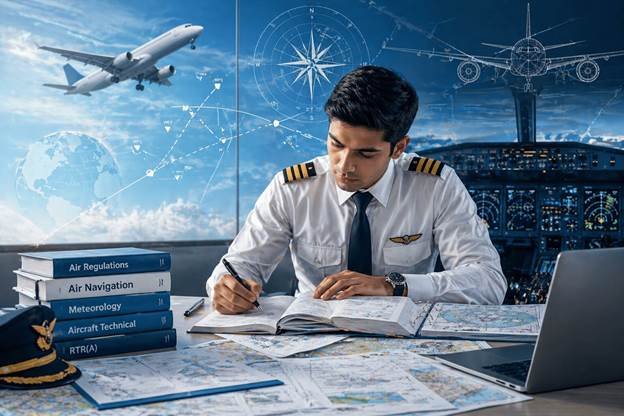
Airline interviews are not just about your logbook. Recruiters are trained to spot gaps quickly, and they usually test for a few consistent things.
- Technical clarity: Can you explain a system or procedure simply, without stumbling?
- Decision-making under pressure: How do you react when a scenario changes mid-question?
- Communication tone: Calm, clear, and professional, especially on radio-style questions.
- Regulatory awareness: Do you actually understand DGCA rules, or did you just memorize them for the exam?
Students who come from a rushed or purely exam-focused background often struggle here, even if they cleared their ground papers with good marks. Marks and readiness are not always the same thing. That is a lesson a lot of students learn the hard way, unfortunately, right before an interview instead of well before one.
How Structured Timelines Change the Outcome
One thing that separates a good training for pilot in india from an average one is timeline discipline. The aviation industry is not an industry that can be learned on the job. A well-paced program typically will be: subjects being taught in a logical sequence on the ground, revision being scheduled regularly, mock exams reflecting the real DGCA format, and RTR being introduced into the program as near to the start of flying training as possible to ensure communication is kept fresh.
When students have a planned order in which they work, they remember what they have learned more effectively, as there is no sense of urgency. Learning Meteorology in the last two weeks before a test could pass the person through it, but does not produce the kind of understanding an airline wants.
Conclusion
Airline-ready training is not a course or an exam. It is a complete progression, from solid ground school to simulator training to the confidence that airlines are seeking when they recruit. Rushing any stage of this, especially Commercial Pilot License Preparation, tends to show up later as gaps during interviews or early flying training struggles.
The students who take this process seriously from the first day they are enrolled in ground school, who see it as a way to prepare for their career instead of just studying for a test, are generally more confident and more employable when they come out of the school “airline ready”. For a pilot, that mindset, more than any other, is what defines him from a pilot who has a license to a pilot who is truly ready for the cockpit. Pilot Training Academy Pune has built its entire teaching approach around exactly this idea.
FAQs
What does airline ready pilot training actually include?
It typically covers DGCA ground subjects, RTR communication training, simulator exposure, and mock interview-style preparation, alongside the core CPL or ATPL theory classes.
How long does Commercial Pilot License Preparation usually take?
Most CPL ground training programs run for several months, depending on the student’s pace, batch schedule, and how thoroughly each subject is covered.
Is simulator training necessary before flying training begins?
It’s not always mandatory, but it’s highly recommended. Simulator exposure helps students get comfortable with cockpit procedures before handling a real aircraft.
Do airlines only look at flying hours during recruitment?
No. Airlines also assess technical clarity, communication skills, and decision-making, which is why ground school performance matters just as much as flight experience.
Can ground classes for CPL be done alongside other commitments?
Many institutes now offer hybrid or online-offline formats, which makes it possible for students to prepare for CPL without disrupting their full schedule.